
Eliminating numerical instability to enable accurate thermo‑mechanical brake design
This case study is the summary of Abdulla Toma‘s Masters Thesis work on braking performed at RMIT Melbourne. It demonstrates how advanced non‑linear and thermo‑mechanical finite element modelling was used to eliminate numerical instability in automotive brake simulations. The result is design‑grade insight suitable for safety‑critical components – reducing reliance on physical testing and enabling earlier, more confident engineering decisions.
Key Outcomes
- Stable, design‑grade contact pressure prediction under rotation
- Removal of artificial numerical instability
- Validated coupled thermo‑mechanical response
- Improved confidence in brake factor and durability predictions
- Reduced dependence on costly physical prototyping
The Challenge
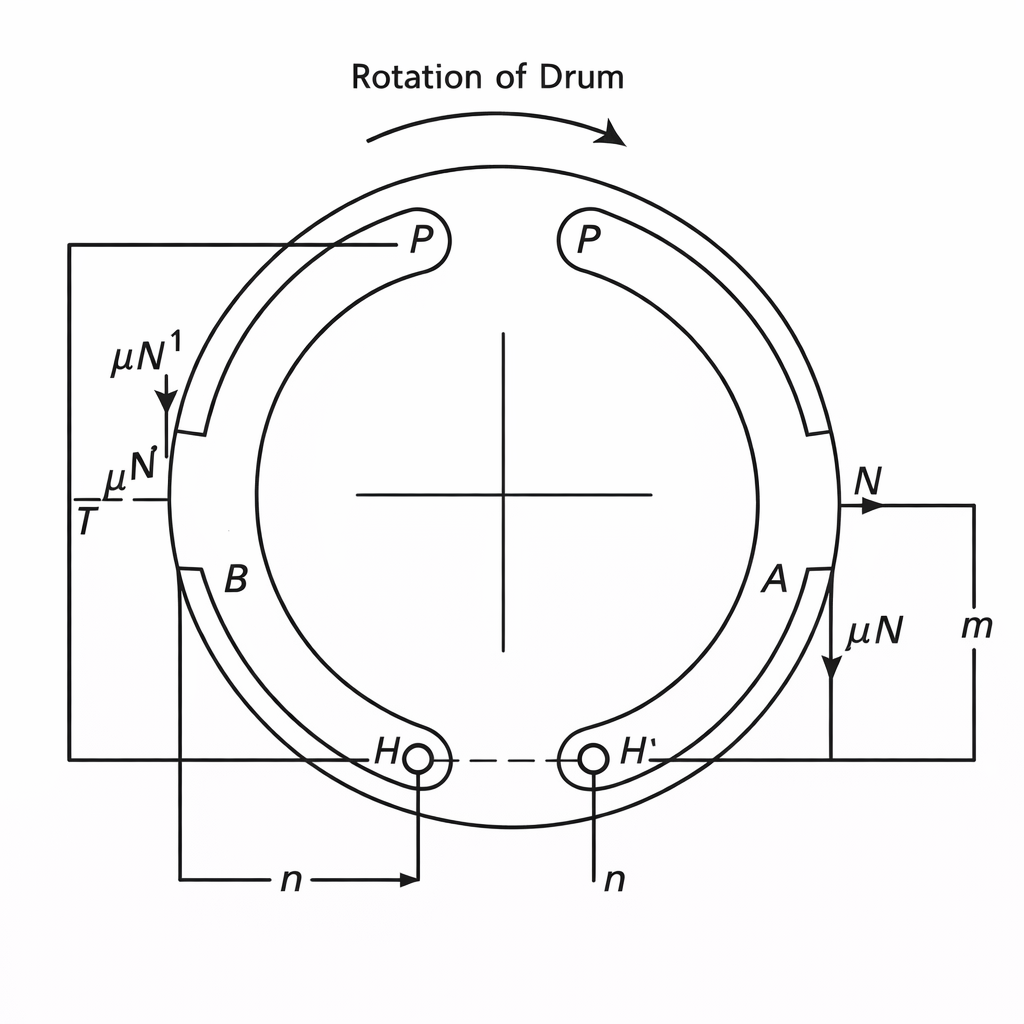
During braking, large amounts of kinetic energy are converted into heat through friction between the brake drum and shoe. This creates extreme mechanical and thermal loading, making accurate performance prediction essential at the design stage.
Conventional drum brake design methods rely on simplified analytical equations that assume rigid components, uniform pressure, and constant friction. These assumptions lead to poor prediction of brake effectiveness, durability, and thermal limits.
Physical testing improves realism but is slow, costly, and unsuitable for early design iteration. Earlier finite element studies attempted to bridge this gap, but many reported unexplained numerical instability, undermining confidence in simulation results.
Working on high‑load or thermal‑critical components where numerical instability is a risk?
Talk to us about design‑grade non‑linear and thermo‑mechanical FEA – before costly testing and late‑stage redesigns. Please reach out to Andymus Consulting to discuss how we can help.
Engineering Objective
The objective of this work was to deliver a validated, design‑ready finite element framework that:
- Predicts realistic contact pressure and brake factor
- Captures thermal–mechanical coupling effect during braking
- Eliminates artificial numerical fluctuation
- Supports design optimisation before prototyping
Modelling Approach
A progressive modelling strategy was implemented in ABAQUS, moving deliberately from problem reproduction model to robust solution.
1. Preliminary Mechanical Model
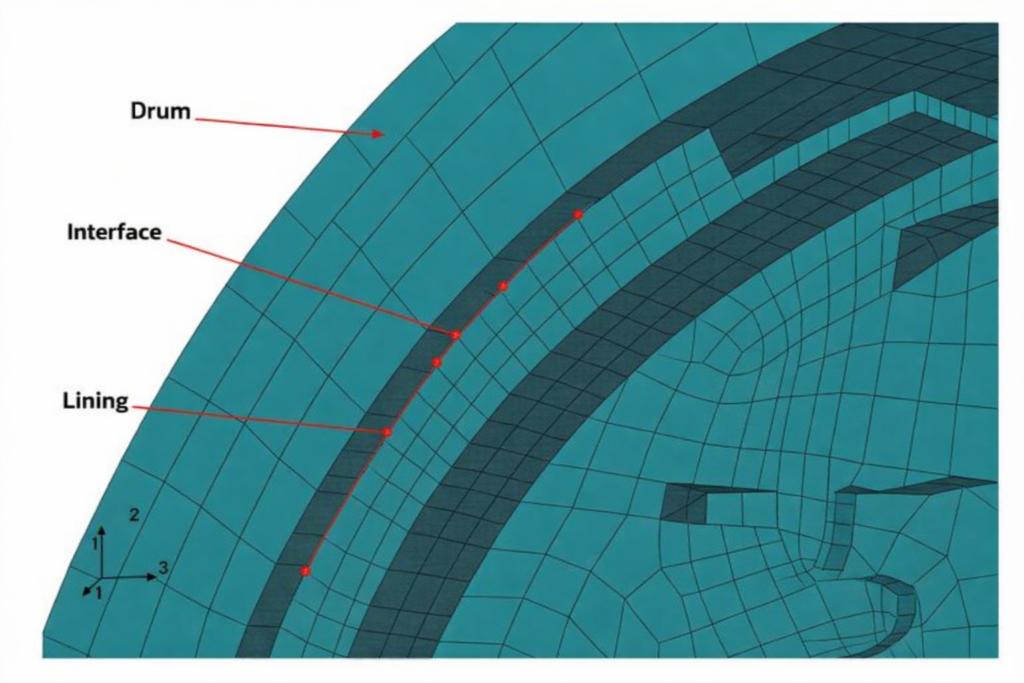
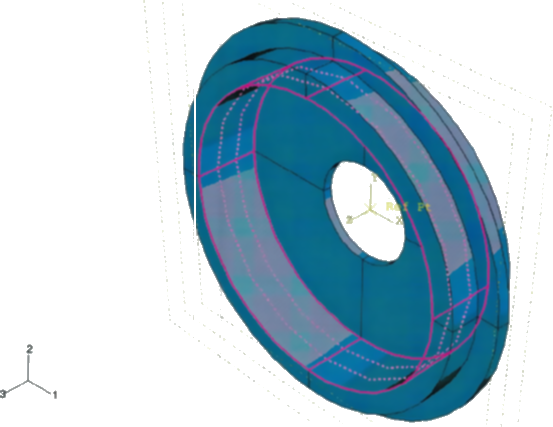
A 3D mechanical FEA model of a single‑shoe drum brake was developed to reproduce the instability reported in literature. This model confirmed the issue was structural in nature rather than a solver artefact.
2. Root Cause Investigation
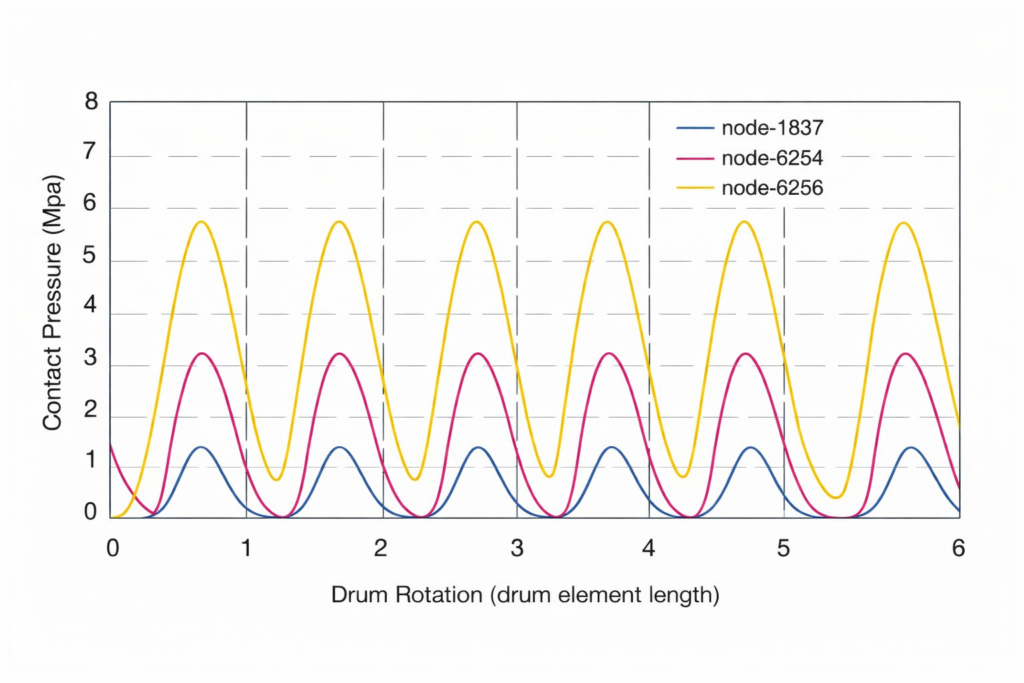
Detailed interrogation showed instability was driven by geometric discretisation errors, including first‑order elements on curved surfaces and mismatched contact meshes. As the drum rotated, the effective contact diameter changed numerically, forcing oscillation in pressure and brake factor.
Key Innovation
Two production‑grade modelling techniques were developed to permanently remove this instability.
Advanced Model 1 – Geometric & Increment Control
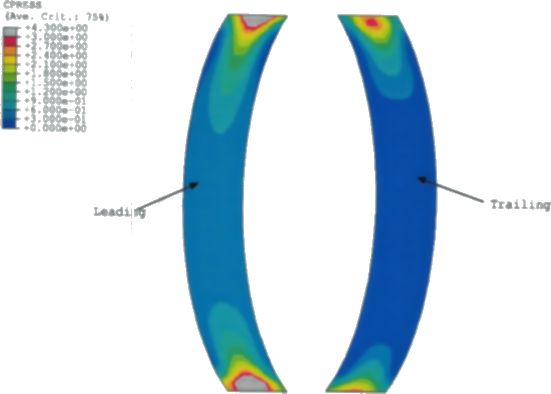
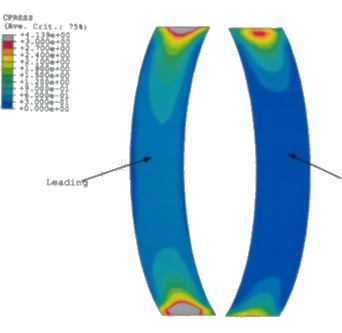
Stability was achieved by enforcing geometric consistency at the contact interface and synchronising rotational increments with mesh topology. This produced smooth, physically realistic pressure distributions suitable for short‑duration events.
Advanced Model 2 – Surface Multi‑Point Constraint (SMPC)
To model realistic manufacturing clearance, a second‑order shell surface was introduced and tied to the corresponding drum surface via a surface multi‑point constraint. This enabled accurate contact prediction even with initial gaps.
Coupled Thermo‑Mechanical Analysis
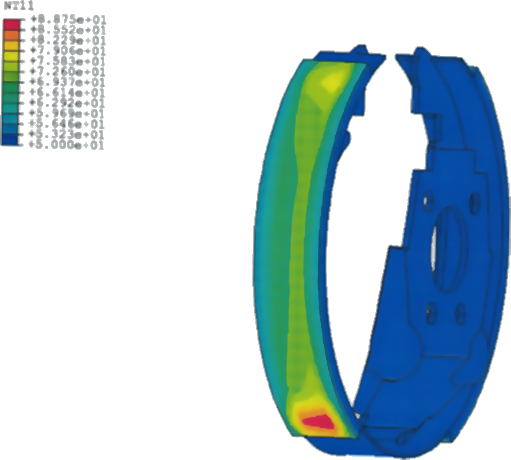
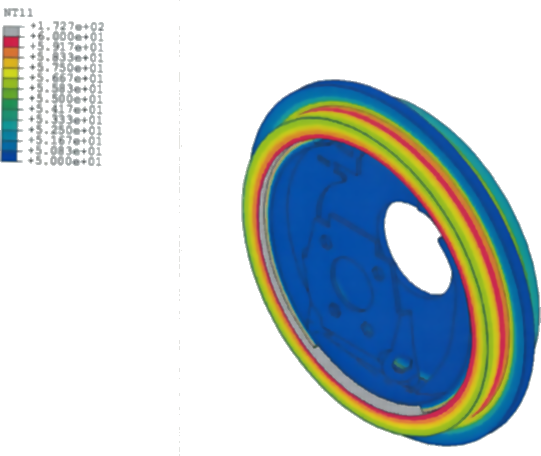
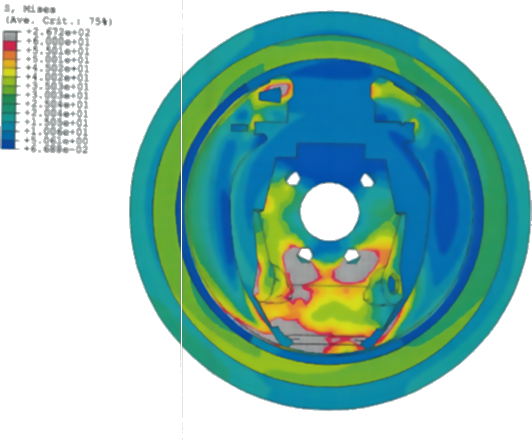
With mechanical stability proven, fully coupled thermo‑mechanical simulations were executed. These captured frictional heat generation and distribution, temperature‑dependent material response, thermal expansion, and stress redistribution during sustained braking.
Key Results
Contact Pressure
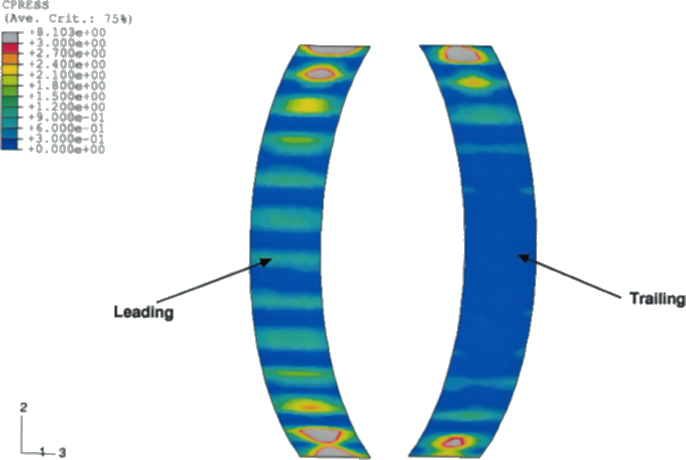
The advanced models eliminated artificial fluctuation and produced stable pressure fields aligned with theory and test evidence.
Brake Factor
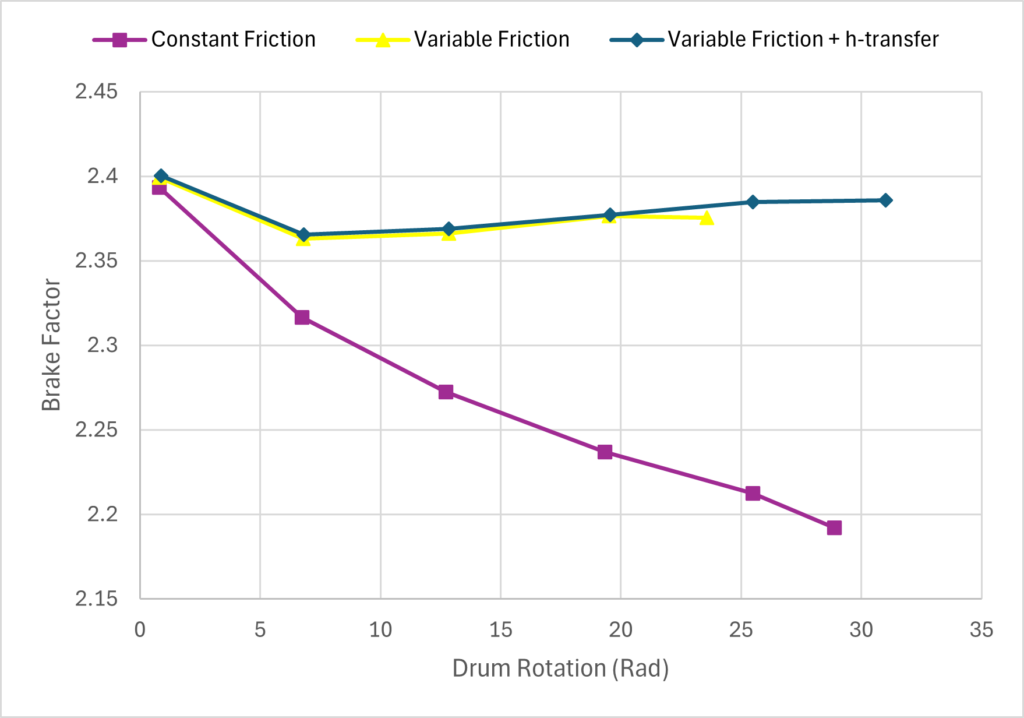
Brake factor remained stable under rotation. Thermal expansion reduced effectiveness over time, while temperature‑dependent friction partially offset this reduction.
Temperature & Stress
Peak temperature aligned with pressure concentration. More uniform pressure reduced both thermal and structural extremes.
Design Insights
This work generated actionable design guidance:
- Small, intentional clearance reduces peak pressure and temperature
- An optimal gap exists, governed by geometry and material stiffness
- Softer friction materials promote more uniform contact
- Shoe stiffness dominates system response more than drum stiffness
Business Value
This case study shows how advanced simulation replaces trial‑and‑error design. For Andymus Consulting clients, it enables faster decisions, reduced testing cost, and higher confidence in safety‑critical components.
Where This Capability Applies
This work draws on deep expertise in contact mechanics, numerical stability control, and production‑grade non‑linear FEA using ABAQUS.
- Automotive and heavy‑vehicle braking systems
- Off‑highway and industrial equipment
- Rail braking applications
- Any system involving high‑load frictional contact with thermal coupling
Need confidence in high‑load, high‑temperature component design?
Andymus Consulting combines advanced simulation with real‑world engineering judgement to help you make better design decisions earlier.
👉 Talk to us about advanced FEA and design optimisation.
Comments are closed