
The Challenge
Offshore structures operate in one of the harshest engineering environments imaginable. Ageing assets, cyclic loading, corrosion, and fabrication defects all contribute to a common and critical challenge, crack initiation and growth in primary load‑bearing components.
At Andymus Consulting, we support operators and asset owners in answering one fundamental question:
Is the structure still fit for service – and if so, under what conditions?
A key part of this capability comes from the work of Abdulla Toma, whose experience spans finite element modelling of offshore jacket structures, fatigue, compliance evaluation, and repair justification. If you need assistance from the team at Andymys Consulting, please contact us to discuss your requirements.
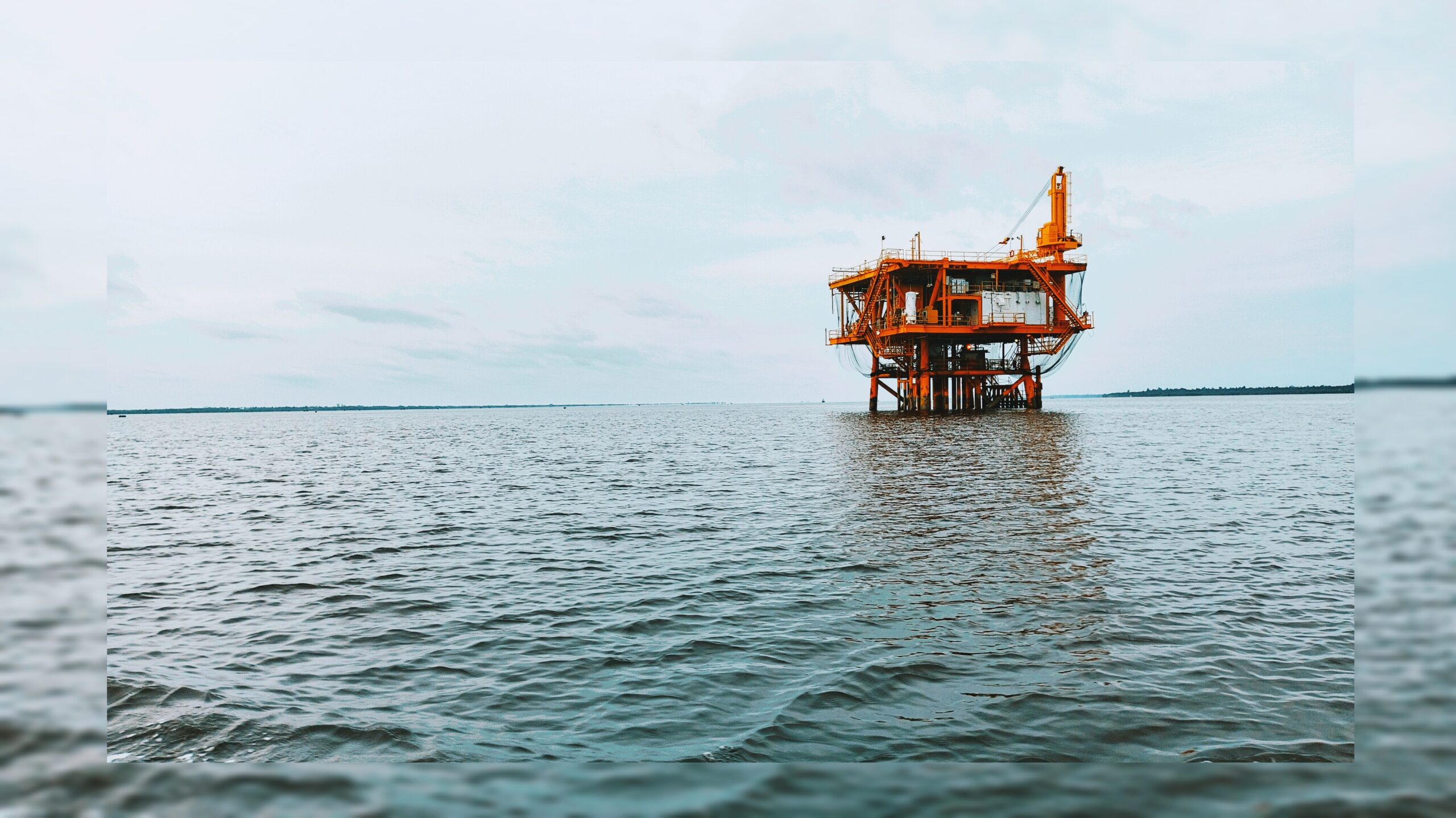
In this case study, assessment and repair approach and assessment will be detailed to tackle an oil rig, with large crack. The crack was discovered in one of the main leg joints during routine inspection.
Engineering Objective
The objective of this work was to:
- Assess the structural integrity of the cracked joint.
- Assess the risk
- Propose and engineer repair
- Assess adequacy of the repaired joint
Modelling Approach
Following methodology was followed to reinstate the cracked joint and make the platform fit for service again:
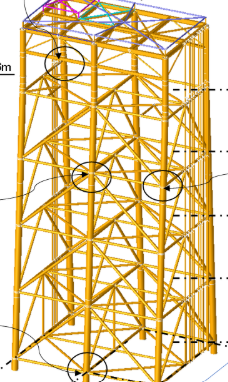
- Performed SACS structural analysis of the platform (as built condition) for the operating conditions.
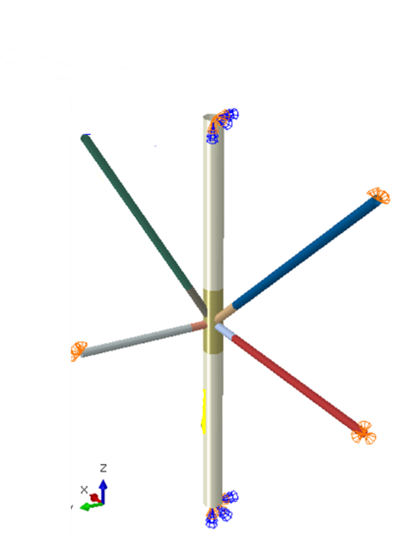
- Using boundary nodes deflections (BND) from the SACS model, FEA analysis of local model of the jacket leg (no crack) was conducted. Stress distribution in the joint are used as reference in the subsequent FEA analysis.
- Using BND from the SACS model, performed FEA analysis of local model of the cracked jacket leg (the crack was explicitly modelled.
- Localised stresses around the crack from FEA were used to run subsequent crack growth analysis.
- Based on stress assessment and crack growth rate, the following repair strategy was proposed:
- Cut the diagonal/horizontal brace that is directly responsible for the main load path through the crack.
- Reconnect the brace to the jacket leg by-passing the cracked node with clamping arrangement.
- Grout the leg section, above and below the crack. To model the grouted leg accurately, advanced FE analysis techniques, like contact and geometric non-linearity are used.
- The repair approach restores structural capacity, divert load path from crack, avoid introducing new stress concentrations, and maintain constructability under offshore constraints
- For the jacket with the proposed repair, SACS structural analysis were conducted and the boundary conditions deflection at the boundary nodes were used in subsequent FEA analysis.
- Run FEA analysis using boundary nodes deflections from SACS to assess the repaired joint.
- The jacket leg section, which is filled with grout, is modelled with solid elements. The rest of the modelled jacket members were modelled with shell elements.
- The crack (void) in the jacket is simulated with very soft material, which is fully bonded to the steel, to help with convergence for contact analysis.
- The grout is modelled explicitly within the jacket leg.
- Frictional contact is simulated between the jacket leg shell and the grout assuming perfect contact condition.
- Run FEA analysis using boundary nodes deflections from SACS to design/ assess the clamping arrangement of the member reconnection.
Understanding Offshore Jacket Behaviour through Advanced Modelling
Offshore jacket structures are highly redundant but complex systems. Load paths are three‑dimensional, boundary conditions are non‑linear, and local stress concentrations often govern structural integrity.
Abdulla’s work focuses on developing engineering‑grade finite element models that realistically capture:
- Global load distribution through jacket legs, braces, and joints using joint deflections from global SACS analysis of the platform.
- Boundary conditions representative of real foundation and pile soil interaction and behaviour.
- Combined effects of wave loading, gravity, operational loads, and cyclic fatigue loads.
- Local stress intensification at weld toes and tubular intersections.
Crack Assessment: Moving Beyond Detection to Engineering Decisions
Cracks in offshore structures are not, by themselves, a reason for shutdown. The real question is what the crack means for structural integrity, remaining life, and risk to asset and human life.
Abdulla’s approach bridges inspection data and engineering decision‑making by:
- Translating scan data results into engineering crack representations through use of FEA explicitly modelling the cracks and defects.
- Evaluating crack driving forces under realistic operational load cases
- Assessing fracture and fatigue behaviour using recognised fitness‑for‑service frameworks
- Differentiating between monitor, repair, and operate‑as‑is outcomes
This enables asset owners to move from “we’ve found a crack” to “we understand the consequences”.
Compliance Assessment: Aligning Analysis with Codes and Standards
Regulatory and internal compliance requirements are a critical part of offshore asset management. Crack assessments must align not only with physics – but also with recognised codes and industry practice.
Abdulla’s work supports compliance pathways by:
- Demonstrating structural adequacy against applicable offshore and fracture standards
- API RP 2A Planning, Designing, and Constructing Fixed Offshore Platforms— Working Stress Design
- API 579‑1 Fitness-For-Service
- ASME FFS‑1 FFS-1 – Fitness-for-Service
- DNV rules and standards for offshore units
- Providing traceable assumptions, load cases, and safety factors.
- Supporting regulatory submissions and independent verification processes
- Ensuring engineering judgement is anchored in defensible analysis
This combination of technical depth and compliance awareness is essential when decisions carry operational, financial, and safety consequences.
Engineering‑Led Repair Design and Justification
When a repair is required, the objective is not simply to “fix the crack”, but to:
- Restore structural capacity
- Avoid introducing new stress concentrations
- Maintain constructability under offshore constraints
Through integrated modelling and assessment, Abdulla contributes to repair strategies that are proportionate, targeted, and technically justified, including:
- Evaluation of load redistribution post‑repair
- Assessment of residual stresses and fatigue implications
- Support for repair effectiveness and inspection planning
This ensures repairs are engineered solutions, not reactive interventions.
Engineering‑Led Repair Design and Justification
When a repair is required, the objective is not simply to “fix the crack”, but to:
- Restore structural capacity
- Avoid introducing new stress concentrations
- Maintain constructability under offshore constraints
Through integrated modelling and assessment, Abdulla contributes to repair strategies that are proportionate, targeted, and technically justified, including:
- Evaluation of load redistribution post‑repair
- Assessment of residual stresses and fatigue implications
- Support for repair effectiveness and inspection planning
This ensures repairs are engineered solutions, not reactive interventions.
Fitness‑For‑Service: Enabling Safe and Informed Continued Operation
At the heart of this work is Fitness‑For‑Service (FFS) – providing asset owners with a clear, defensible answer to whether a structure can continue operating safely.
By linking inspection, analysis, compliance, and repair assessment, Abdulla helps deliver:
- Clear FFS conclusions grounded in mechanics, not assumptions
- Confidence for operators, regulators, and stakeholders
- Reduced unnecessary conservatism without increased risk
- Improved decision‑making over inspection intervals and asset life
Practical Engineering for Asset‑Critical Decisions
What distinguishes this work is its practical focus. Offshore integrity assessments are not academic exercises – they directly inform shutdown decisions, repair campaigns, and long‑term asset strategies.
Through his experience in offshore jacket modelling and crack assessment, Abdulla Toma strengthens Andymus Consulting’s capability to support high‑consequence engineering decisions with clarity, rigour, and confidence.
Need a Structural Integrity Assessment?
If you’re managing ageing offshore assets and need defensible answers around structural integrity, repair necessity, or continued operation, this is exactly the kind of engineering depth that matters.
Need a Structural Integrity Assessment? If you’re managing offshore or asset‑intensive infrastructure and need a defensible answer on crack severity, repair strategy, or fitness‑for‑service:
Comments are closed