
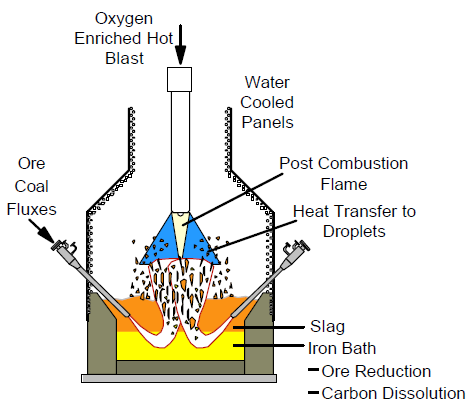
This case study is based on doctoral research undertaken at the University of Greenwich (UK) in collaboration with HIsmelt Corporation Pty Ltd and Rio Tinto Technology. The work developed an integrated simulation framework to predict refractory wear, freeze layer formation, and cooling feasibility in high‑temperature direct smelting processes.
The Challenge
Direct smelting furnaces operate under extreme thermal and chemical conditions, where small design decisions can have major consequences for safety, availability, and campaign life.
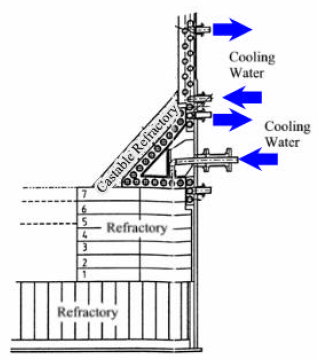
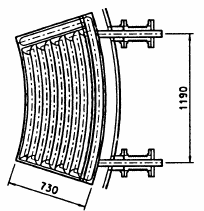
Key challenges included:
- Predicting refractory wear under highly variable operating conditions
- Understanding whether freeze layers would protect or destabilise the furnace lining
- Evaluating the feasibility of water‑cooled elements close to molten slag
- Making design decisions with limited empirical data and high risk exposure
At the time, industry lacked a predictive, physics‑based modelling framework capable of addressing these issues in an integrated way.
The Approach
This work developed a tightly coupled multiphysics simulation framework combining:
- Computational Fluid Dynamics (CFD)
- Solidification and phase‑change modelling
- Free‑surface and multiphase flow
- Explicit refractory wear mechanisms
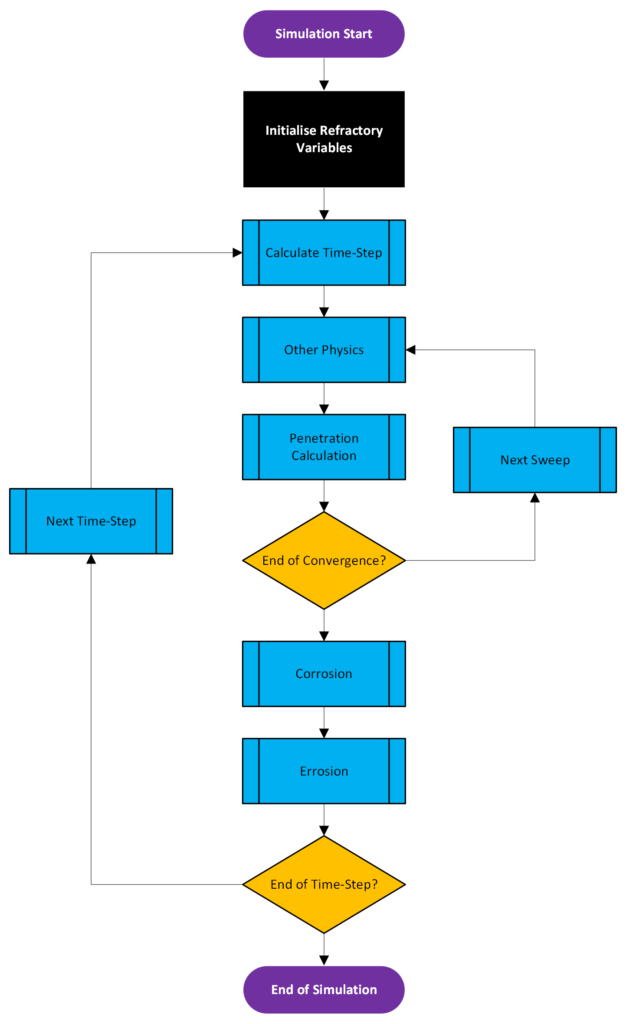
The models were implemented using a finite‑volume, unstructured mesh CFD framework (PHYSICA) and applied directly to industrial smelt reduction vessels, rather than simplified academic geometries.
A key innovation was treating refractory wear as a dynamic, evolving system, rather than a static boundary condition.
What Was Modelled
The modelling framework was applied across several real‑world scenarios, including:
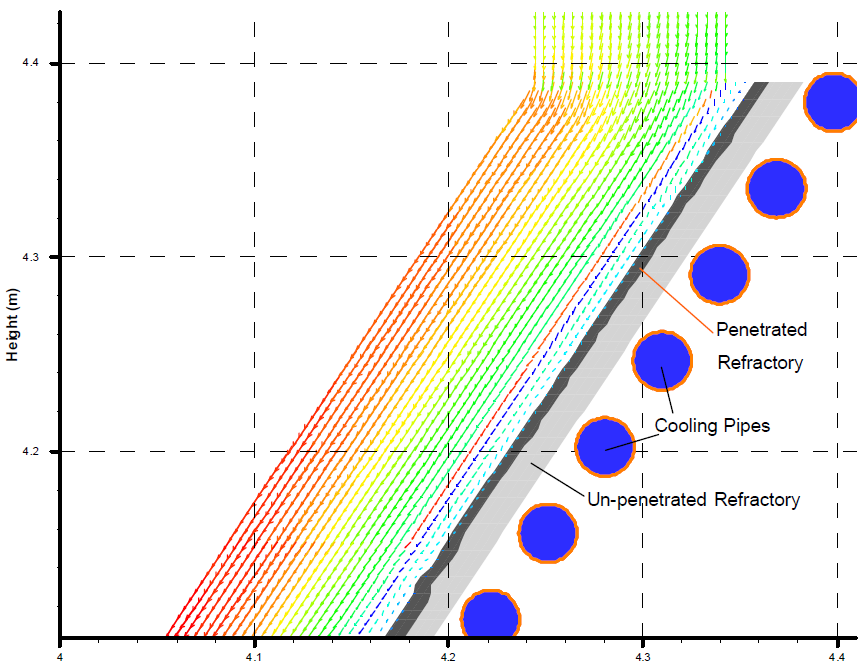
- Freeze layer formation on water‑cooled furnace elements
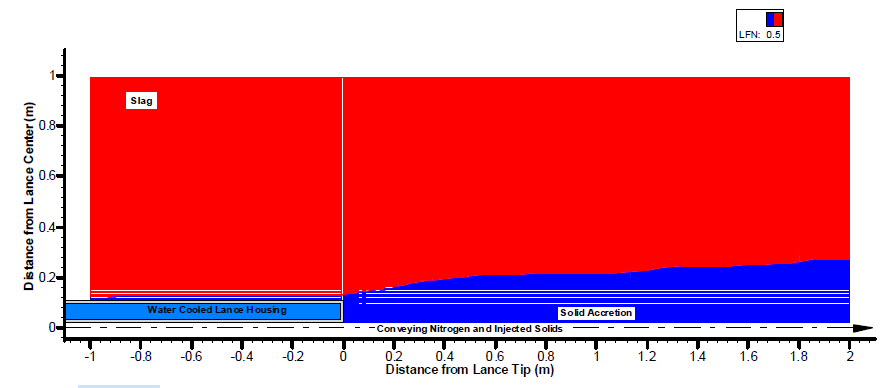
- Accretion growth (“Elephant Trunks”) on solids injection lances
- Refractory wear in pilot‑scale smelt reduction vessels
- Laboratory validation using induction furnace and rotary slag tests
Each model was validated against measured plant or test‑scale data, ensuring results were grounded in operational reality.
Key Technical Insights
The research delivered several insights with direct engineering relevance:
- Refractory wear is driven primarily by temperature excursions, not steady operation
- Freeze layers form naturally once thermal equilibrium is reached
- Water‑cooled designs can be viable when freeze layer behaviour is explicitly considered
- Cooling strategies must be evaluated as system‑level interactions, not isolated components
This shifted decision‑making from “Can this be cooled?” to “Under what operating envelope is cooling self‑stabilising?”
Outcomes & Impact
The modelling framework provided:
- A defensible basis for evaluating water‑cooled stave designs
- Improved understanding of refractory life‑limiting mechanisms
- Reduced reliance on conservative over‑design
- A structured way to link process variability to asset degradation
The work bridged the gap between advanced simulation and practical industrial decision‑making in high‑risk environments.
Why This Matters Today
This case study underpins how Andymus Consulting approaches complex engineering and operational problems:
- Simulation as a decision support capability, not just analysis
- Explicit treatment of degradation, uncertainty, and time‑dependence
- Integration of physics, materials, and operations
- Translation of complex modelling into clear, defensible decisions
These principles are now applied across resources, energy, infrastructure, and advanced SME advisory engagements.
Key Takeaway
The real value of simulation lies in predicting how systems evolve over time — not just how they perform at a single point.
Reference
An PDF download of the thesis for this research is available from the Univeristy of Greenwich.
The work was performed by Andrew Campbell, under the supervision of Prof Koulis Pericleous and Prof Mark Cross in collaboration of Chris Cross who supported from the Office of the Chief Technologist, Rio Tinto Technology.
Comments are closed